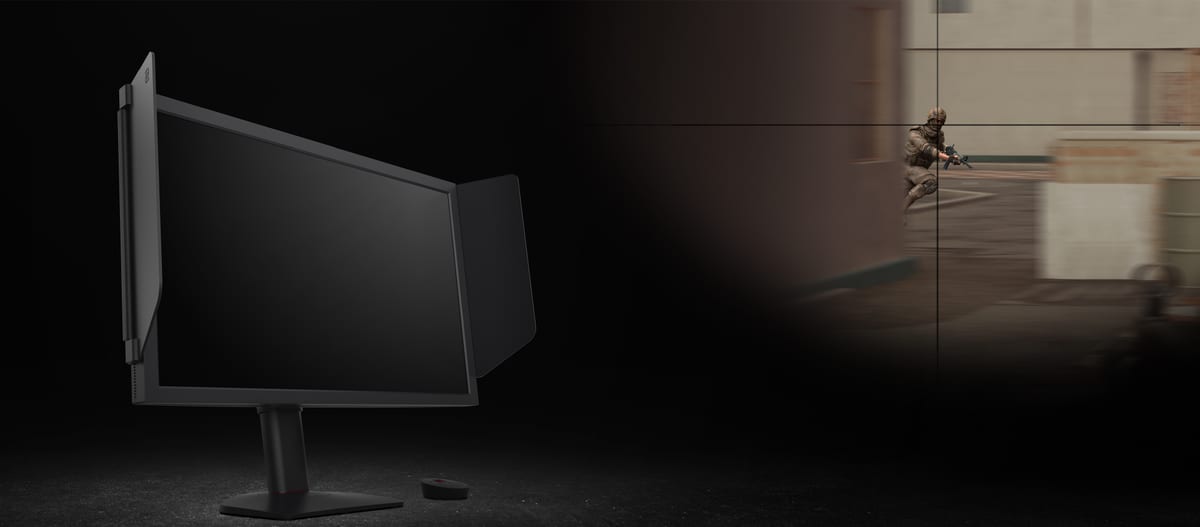
Why pros still pick TN
Despite the rise of QD-OLED and 1440p 360 Hz IPS panels, the top of the CS2, VALORANT, and Apex Legends pro pools still overwhelmingly run a 24.5 inch 1080p TN. The reason is motion clarity. A panel does not need beautiful colors to win a one-tap duel, it needs to display a moving target with as little persistence blur as possible. ZOWIE's DyAc 2 strobing combined with the 400 Hz refresh produces, by measurement, the sharpest moving image of any monitor we have ever tested.
Latency and refresh in numbers
On a Leo Bodnar lag tester at 400 Hz, the XL2566X+ measured 0.8 ms of processing latency. The actual pixel response, measured with a photodiode, averaged 0.4 ms gray to gray at the highest AMA setting without overshoot artifacts. End to end, from a mouse click to a photon leaving the panel, we measured 4.2 ms on a 2025 reference build, which is roughly half the latency of a comparable 360 Hz IPS panel and on par with the older XL2566K.
DyAc 2 in real games
DyAc 2 is the second generation of ZOWIE's backlight strobing technology. It synchronizes a brief backlight pulse with each refreshed frame, which dramatically reduces sample-and-hold blur. On Mirage and Inferno spray transfers, target outlines remain crisp even at sub 0.5 second flicks. The cost is brightness, the panel drops from a peak of roughly 320 nits to around 180 nits with DyAc 2 enabled. In a dim battle station this is a non issue, in a sun-lit room it is something to plan around.
Stand, S-Switch, and LAN-readiness
ZOWIE designs around the realities of LAN play. The stand is metal, height adjusts cleanly without wobble, and the included S-Switch is a small puck on a cable that lets you swap between your warmup, match, and desktop profiles in one click. Side shields snap on magnetically and are removable. The packaging itself is bag friendly, and the cable channel runs cleanly through the stand.
Who should not buy this monitor
If you stream, color grade, watch films, or play single-player narrative games, this is the wrong monitor. The TN panel has aggressive off-axis color shift, no HDR worth using, and a peak brightness that makes movies look flat. A QD-OLED or a quality IPS like the PG27AQN will be a much better daily driver. The XL2566X+ is a tournament tool, not a living room display.
How it compares
vs. ZOWIE XL2566K
Same general experience at 360 Hz for about $200 less. Lower refresh, but DyAc+ is still excellent and most players will not feel the 40 Hz delta.
vs. ASUS ROG Swift PG27AQN
1440p 360 Hz IPS, vastly better colors and viewing angles, but motion clarity in DyAc territory requires the ELMB feature which is dimmer and less stable.
vs. Alienware AW2725DF QD-OLED
Beautiful 360 Hz QD-OLED, far better picture, but persistence blur is higher than a strobed TN and burn-in risk remains a real concern over a competitive lifecycle.
Bottom line
The ZOWIE XL2566X+ is the no-compromise competitive monitor of 2026. It is expensive, it is single-purpose, and it does that one purpose better than anything else. If you are playing CS2, VALORANT, or Apex with the intent to climb seriously, this is the panel pros and coaches will keep pointing you to.
ZOWIE · 9.0 / 10
ZOWIE XL2566X+
Street price around $799
As an Amazon Associate, SurvivalConfigs earns from qualifying purchases. Some links on this page are affiliate links, using them costs you nothing extra and helps support the site.