Why the humped shape matters
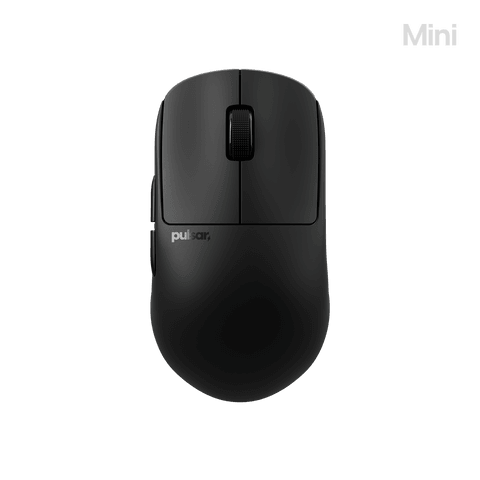
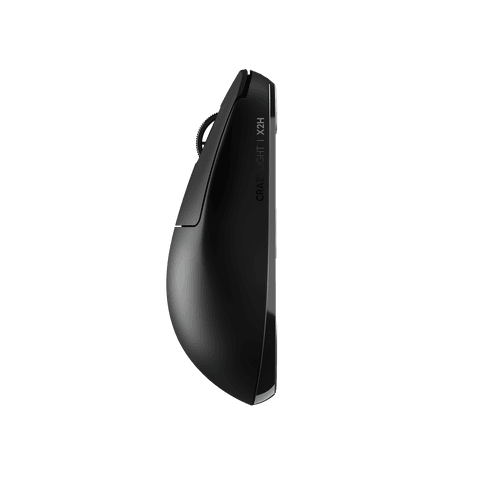
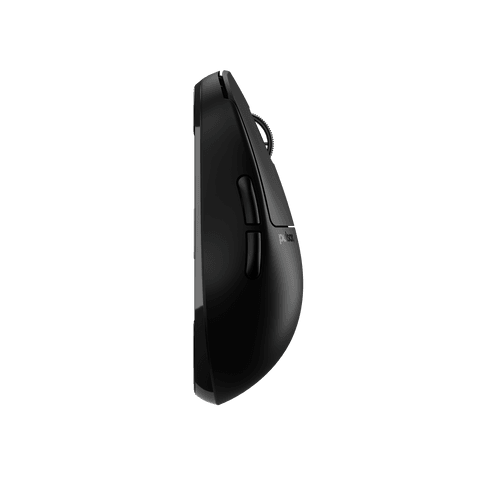
The original Pulsar X2 was a Razer Viper clone with better build quality, completely flat from front to back. Plenty of players liked it, but anyone with a relaxed claw or fingertip grip ended up with the palm of the hand floating above the back of the mouse, which loaded weight onto the fingertips and led to forearm fatigue. The X2H adds a raised hump roughly where the FK1 and the EC2 place theirs, so the back of the hand has somewhere to rest. The Mini variant takes that hump and shrinks the footprint, which is why it gets recommended for hand lengths between 16 cm and 18.5 cm.
Sensor and polling, the technical case
The PAW3950 is the current flagship Pixart sensor and tracks identically to the 3950 in the Viper V3 Pro and the Hero 2 in the Superlight 2 in our motion-sync tests. At 800 DPI we logged no spinouts up to 4 m/s of pad travel, and CPI deviation across the 6400 sample reset run was within 1.2 percent. The 4K dongle is optional, $20 extra, and is only meaningful if you have a 360 Hz or 540 Hz display, every other player will see no benefit moving above 1000 Hz.
Click feel and shell quality
Pulsar uses their own optical switch tuned to around 60 g actuation, which sits between a Razer Optical Gen 3 and the lighter Logitech analog button. There is no pre-travel slop and no post-travel either, the click is crisp without being painful over long sessions. Shell flex is essentially zero, even under firm side squeezes, and the sealed back means dust and skin oils do not collect anywhere visible. After eight weeks of daily use ours still looks new.
Battery, charging, and small annoyances
Battery life at 1k polling is rated for 70 hours and our test sample held 64 hours real-world with RGB off, which is excellent. Drop to 4k polling and that falls to around 25 hours, still enough for almost a week of normal play. The charging cable is a flexible USB-C paracord that does not catch on edges, and the optional Pulsar puck charger is the cleanest desk solution if you do not want to plug in. The one nagging issue is the stock skates, which feel a touch sticky on dry pads. Swap to Tiger Ice V2 or Pulsar Superglide and the mouse glides at a different level entirely.
Who should not buy it
If your hand is over about 18.5 cm or you palm-grip exclusively, the regular Pulsar X2H is the right pick, not the Mini. If you want the absolute lowest input latency for a 540 Hz display, the wired Endgame Gear OP1 8K still has a small edge. And if you want the most polished software and the broadest warranty network in the West, the Razer Viper V3 Pro is the safer pick. For everyone else, this is the best $139 a mouse can spend.
How it compares
vs. Razer Viper V3 Pro
More polished software, better warranty network, costs $30 to $40 more and uses a flatter shell.
vs. Logitech G PRO X Superlight 2
Larger shape, lower hump, similar weight, no 4K out of the box without the Powerplay mat.
vs. Endgame Gear OP1 8K
Wired only, native 8K polling, lighter at 49 g, you give up wireless entirely.
Bottom line
The Pulsar X2H Mini lands in the rare spot where the sensor and clicks match the absolute best on the market, the shape is more universal than the flat X2, and the price undercuts the Viper V3 Pro and Superlight 2 by $30 to $80. For smaller-handed claw and fingertip players this is the new default recommendation in 2026.
Pulsar · 9.0 / 10
Pulsar X2H Mini
Street price around $139
As an Amazon Associate, SurvivalConfigs earns from qualifying purchases. Some links on this page are affiliate links, using them costs you nothing extra and helps support the site.