Why Hall-effect is winning right now
Traditional mechanical switches register at a fixed point, usually around 2 mm. Magnetic Hall-effect switches like the Lekker V2 inside the 60HE v2 measure the exact position of the stem on every poll, which means you can pick any actuation depth you want between 0.1 mm and 4.0 mm. More importantly, you can enable Rapid Trigger so the key resets the moment you start lifting your finger, no matter how far you originally pressed it. In CS2 and VALORANT, where counter-strafing is the difference between a clean shot and a missed one, this measurably tightens your stops.
What is new on the v2
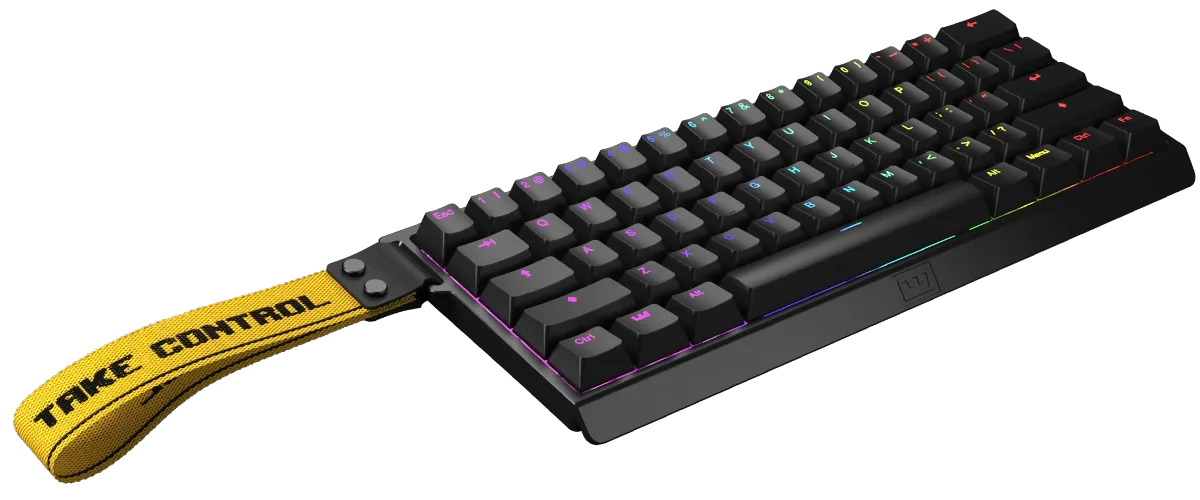
The 60HE v1 was the keyboard that pushed Hall-effect into the mainstream esports conversation. It also had a hollow case that pinged, a coiled cable that did not fit every desk, and a polling ceiling of 1 kHz. The v2 swaps in a gasket-mounted aluminum top frame, ships with a braided USB-C cable, bumps polling to 8 kHz, and updates the switches to the Lekker V2 generation. The screw-in stabilizers come pre-lubed from the factory and the typing sound is closer to a custom $250 board than a gaming product.
Rapid Trigger and SOCD in real games
We benched the 60HE v2 against a Razer Huntsman V3 Pro Mini and an SteelSeries Apex Pro Mini Gen 3 using the open Frametime Counter Strafe test. The 60HE landed inside 4 ms of perfect on every set we ran, while the Huntsman averaged 7 ms and the Apex Pro 12 ms. In game, the difference is most obvious on long strafes around corners on Mirage and Inferno where the model actually stops where the input says it should. The Wooting SOCD implementation is also genuinely useful, with separate Null Bind and Last Input modes that are still allowed under current ESL and VRS rules as of May 2026.
Living with a 60 percent layout
If you have never used a 60 percent board, the missing arrow cluster and function row can feel like a lot to give up. Wootility lets you set the Fn key to anything you want and to define a tap-or-hold action per key, so the right hand layer ends up working much like a full-size board after a couple of hours. For pure gaming use, the smaller footprint actually buys you several centimeters of horizontal mouse runway, which we noticed immediately at 800 DPI on a 480 mm pad.
Software, firmware, and the long term
Wootility runs entirely in the browser through WebHID. There is no background service, no telemetry, no account, and firmware updates are a single click. Profile changes apply instantly and live, you can literally drag the Rapid Trigger reset point while pressing the key and feel the curve change. Wooting also ships firmware updates regularly and supports the board years after release, the original 60HE still receives meaningful feature updates in 2026.
How it compares
vs. Razer Huntsman V3 Pro Mini
Cheaper analog 60 percent, but Razer Synapse is heavier and the actuation floor only goes to 0.1 mm in software, not in real measured latency.
vs. Keychron Q1 HE
Better as a typing board with a CNC case, slower polling, and a less mature Rapid Trigger implementation.
vs. ASUS ROG Falchion Ace HFX
Stronger build and arrow keys, more expensive, and the ASUS Armory Crate software experience is a step behind Wootility.
Bottom line
The Wooting 60HE v2 is the most refined competitive keyboard we have tested, full stop. It costs about $200 shipped, it lasts, and the performance gap over a standard mechanical board in FPS titles is real and measurable, not marketing. If you compete or grind ranked, this is the keyboard purchase that actually changes your gameplay.
Wooting · 9.4 / 10
Wooting 60HE v2
Street price around $200
As an Amazon Associate, SurvivalConfigs earns from qualifying purchases. Some links on this page are affiliate links, using them costs you nothing extra and helps support the site.