Build Quality and Ergonomics
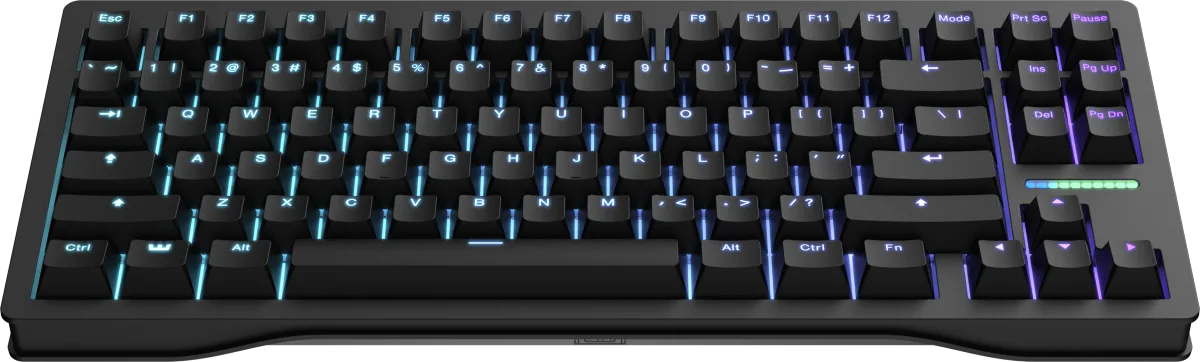
The 80HE leans into restrained Dutch design. The chassis is a low profile aluminum tray with a PBT double shot keycap set, gasket isolated PCB, and pre lubed stabilizers that ship quiet out of the box. At roughly 1.1 kg it sits between a typical TKL and a custom group buy build. The detachable USB-C cable, the south facing per key RGB, and the recessed status LEDs feel deliberate rather than gamer maximalist. Typing acoustics land in the muted thock register, with no spring ping and minimal case hollowness.
Performance and Latency
Performance is where the 80HE separates itself. Lekker L60 magnetic switches read continuous travel rather than a single trigger point, so you can set actuation as shallow as 0.1 mm for spammy keys and as deep as 4.0 mm for binds you do not want to misfire. Rapid Trigger, which resets the key the instant you start lifting your finger, makes counter strafing in Counter Strike 2 measurably tighter, and the company's own latency telemetry puts end to end click to photon at roughly 1.5 ms over USB. Polling is capped at 1000 Hz, which sounds low next to Razer's 8K, but the actual scan rate of the magnetic sensors is fast enough that competitive testers struggle to feel a difference in blind tests.
Software and Customization
Wootility is the quiet hero of the package. It runs in the browser via WebHID or as a native app, and it stores everything on the keyboard so swapping PCs needs no install. You can map analog ranges to controller axes for racing and flight sims, layer Mod Tap on any key (a long press fires Shift, a short press fires the letter), and tune Rapid Trigger sensitivity in 0.1 mm increments. The Tachyon mode prioritizes new key presses over held ones, which is the technically correct way to handle the Snap Tap debate without crossing tournament rule lines.
Real World Use
After a few hours your fingertips relearn the actuation depth and the gains are real: spray transfers feel smoother, A and D bunny hops land cleaner, and you stop fighting the keyboard during long ranked sessions. The trade off is that returning to a standard mechanical feels sluggish, almost like swimming in pudding. Consider yourself warned.