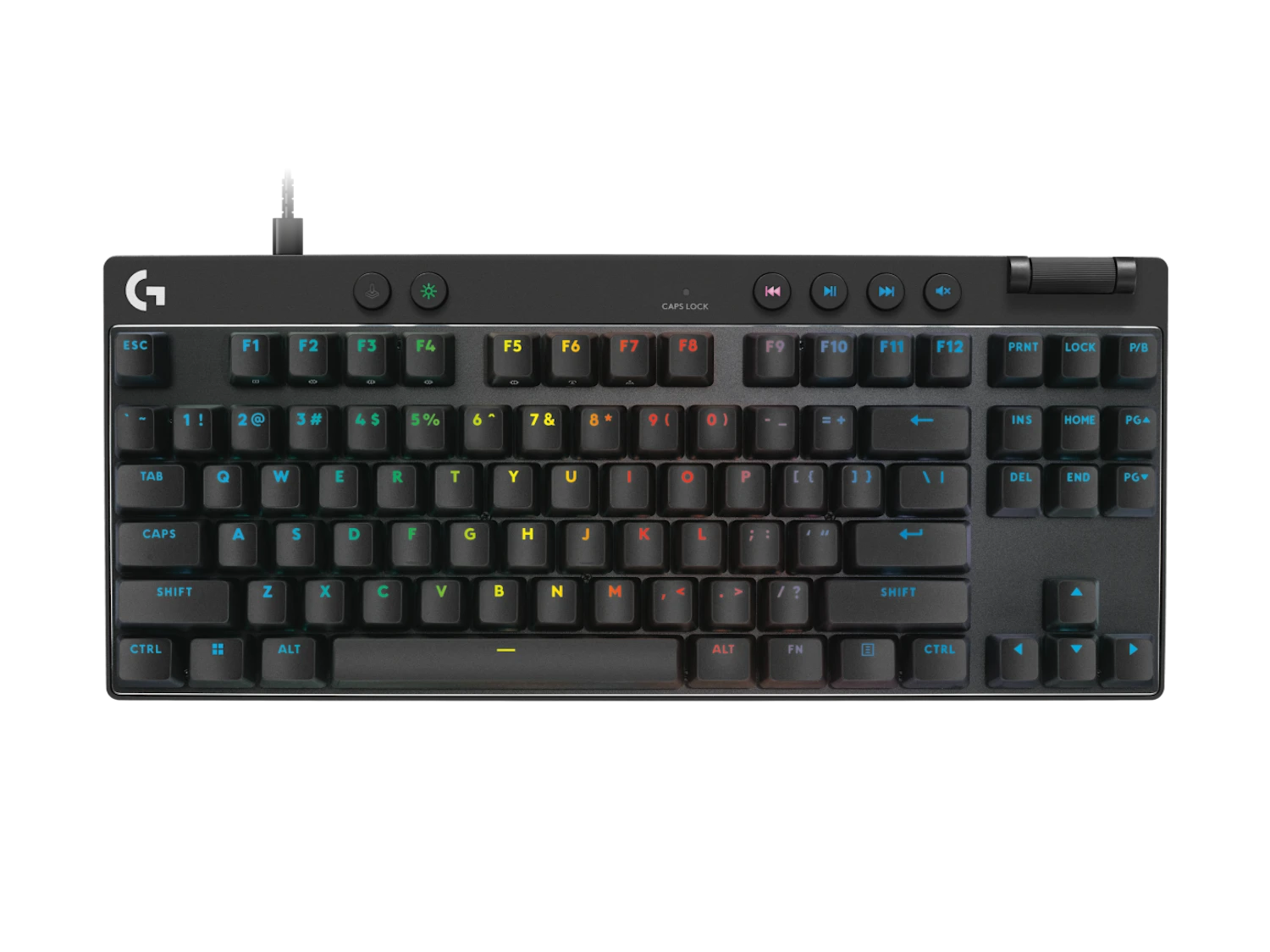
Build Quality and Ergonomics
The Pro X TKL Rapid borrows the chassis of the wireless Pro X TKL: a low profile aluminium top plate over a steel reinforced tray, double shot PBT keycaps in the familiar Logitech G profile, and a detachable braided USB-C cable. The board weighs roughly 980 grams, sits low to the desk without a wrist rest, and has the same understated black colourway that pros tend to gravitate toward. Stabilizers are factory lubed and the typing acoustic is firmly in the muted clack range, with very little case ping or stab rattle out of the box.
Performance and Latency
Analog Hall Effect switches with full 8000 Hz polling are the headline. Per key actuation ranges from a hair trigger 0.1 mm for movement keys to a deliberate 4.0 mm for binds you do not want to misfire, and Rapid Trigger reset values are tunable down to 0.1 mm in 0.1 mm steps. Logitech also ships Dual Key Input, which lets a single physical key fire two distinct actions at different actuation depths, useful for walk plus crouch on the same key. End to end click to photon latency tests put the board on par with the Razer Huntsman V3 Pro and a hair behind the best wired esports mice.
Software and Customization
G HUB is the long standing sticking point for Logitech keyboards, but the Rapid update is the cleanest version of the analog tuning UI in the category. Per key actuation, Rapid Trigger, and Dual Key Input live on a single page with a live visualizer that shows you the current key depth as you press. Profiles store on the board so settings travel between machines without G HUB installed. Onboard memory holds three profiles plus a competition lock that disables macros and Dual Key Input for tournament play.
Real World Use
After two weeks of CS2 and Valorant ranked play the Rapid feels indistinguishable from the Wooting 80HE in counter strafe timing, with a slightly firmer typing feel that some users will prefer for daily writing. The 8000 Hz polling is more about peace of mind than perceptible advantage, but combined with the lower travel ceiling it makes movement keys feel telepathic. The big remaining trade off versus Wooting is the sealed switch design: if a single switch fails you are sending the whole board to RMA.